The return that fits on a calendar
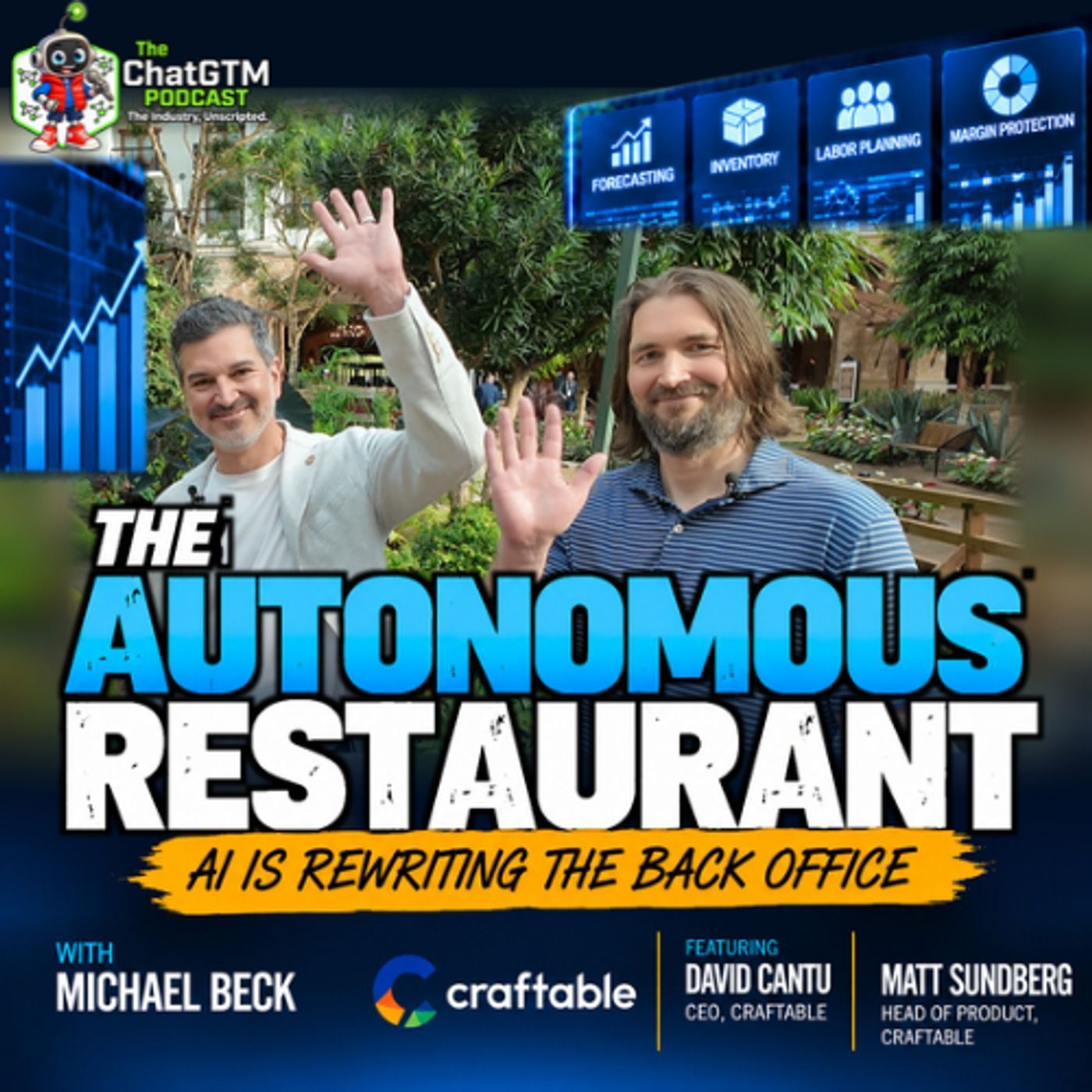
A restaurant manager can finish a shift and still have a second job waiting: reconcile the information, investigate the variance, figure out what to order. In their ChatGTM conversation with Beck at FSTEC, Craftable CEO David Cantu and product leader Matt Sundberg describe a back office designed to shorten that second job. The ambition is an autonomous operation. The immediate test is whether people get useful time back.
Sundberg tells the story of a customer who said an AI analysis tool had reclaimed his nights and weekends. The customer had recently had a child. It is one customer's account, not a measured promise for every restaurant, but it gives the technology discussion a concrete destination. A faster report has value when the person who used to assemble it can actually stop working.
That standard is harder than adding an assistant to a screen. It asks a product team to understand the work well enough to remove parts of it without leaving the operator responsible for an invisible mess.
Trust grows inside the task
Cantu describes Craftable's direction as a connected back office in which a sales forecast informs ordering and prep production, with labor planning also part of the work being developed. This is a product vision and a description of the team's direction at the time of recording. It should not be read as a claim that every restaurant can already switch off supervision.
Sundberg's examples are deliberately ordinary. Someone needs to place an order. Someone has a handwritten recipe to enter. AI becomes useful when it helps complete those tasks inside the existing workflow, instead of presenting another blank box that the manager must learn to prompt.
He also stresses showing the work. The path he describes moves from repeated review toward confidence: an operator sees the recommendation, understands it and eventually needs fewer steps to act. Trust has to accumulate before convenience can replace inspection. For operators evaluating a tool, our practical suggestion is to ask for an everyday task demonstrated from the original information through to the final decision, including what happens when the recommendation is wrong.
The next manager was not at implementation
Cantu connects weak adoption to restaurant turnover. A rollout can begin with trained managers and lose that knowledge over time, especially where replacement managers have no formal training process. The software may still contain everything the business bought. The person responsible for using it may have no idea where to begin.
Sundberg describes design rules that address that problem at a small scale. Can a new user understand a screen within five seconds? How far must a thumb travel to reach a mobile button? The team watches customers work and looks for clusters of small frustrations it can remove. Those details become part of whether the system feels usable during a busy day.
He groups work into needs, shoulds and coulds. The urgent work gets attention first; less immediate opportunities can wait until the operator has room for them. Our reading is that good prioritization protects attention as well as time. A screen that makes every issue look equally urgent hands the sorting job back to the manager.
Cantu also includes implementation and support teams in the design problem. Their history of customer requests and recurring tickets informs what gets built. The useful question extends beyond whether a feature exists to whether people can get started, recover from confusion and keep using it after the original training is a distant memory.
Find the leak, then check the repair
The conversation moves beyond familiar food and labor percentages to other controllable expenses. Cantu discusses costs captured through invoices and purchase orders, including an example of chemical use. His concern is that managers can miss waste when their attention is narrowed to the usual headline numbers.
Sundberg adds another step: record the action an operator takes, then return later to examine whether the result improved. Identifying a variance is only part of the job. Following the attempted correction makes it possible to learn whether the chosen response helped or whether the team should try something else.
Cantu puts a boundary around cost reduction: the guest and employee experience must remain part of the decision. A restaurant can improve a narrow expense measure while making the overall business less appealing. Our suggested operating habit is to pair each cost experiment with the service consequence the team will watch, and choose a review date before making the change. That is an editorial application of the discussion, not a tested Craftable protocol.
Faster building still needs accountable people
Asked about operators building their own back office with AI, Sundberg describes the work that remains after code appears. Design must make complicated tasks understandable. Code quality needs review. Craftable has retained a QA team, and he discusses the infrastructure required to make the resulting software consistent and maintainable.
The guests also raise data protection. Sundberg describes third-party penetration testing and models brought in-house; Cantu worries about restaurant information being placed into outside AI tools without enough understanding of the settings. These are the guests' descriptions and concerns, not an independent security audit. Buyers still need to verify the controls relevant to their own use.
The practical challenge for a restaurant is to judge the whole operating arrangement, including who maintains it and who responds when it fails. Producing software faster does not remove those responsibilities. The strongest promise in this conversation is the time a restaurant team can reclaim once the system does useful work reliably. Measure that promise against the manager's calendar, and against what the manager can finally leave behind at the end of the shift.